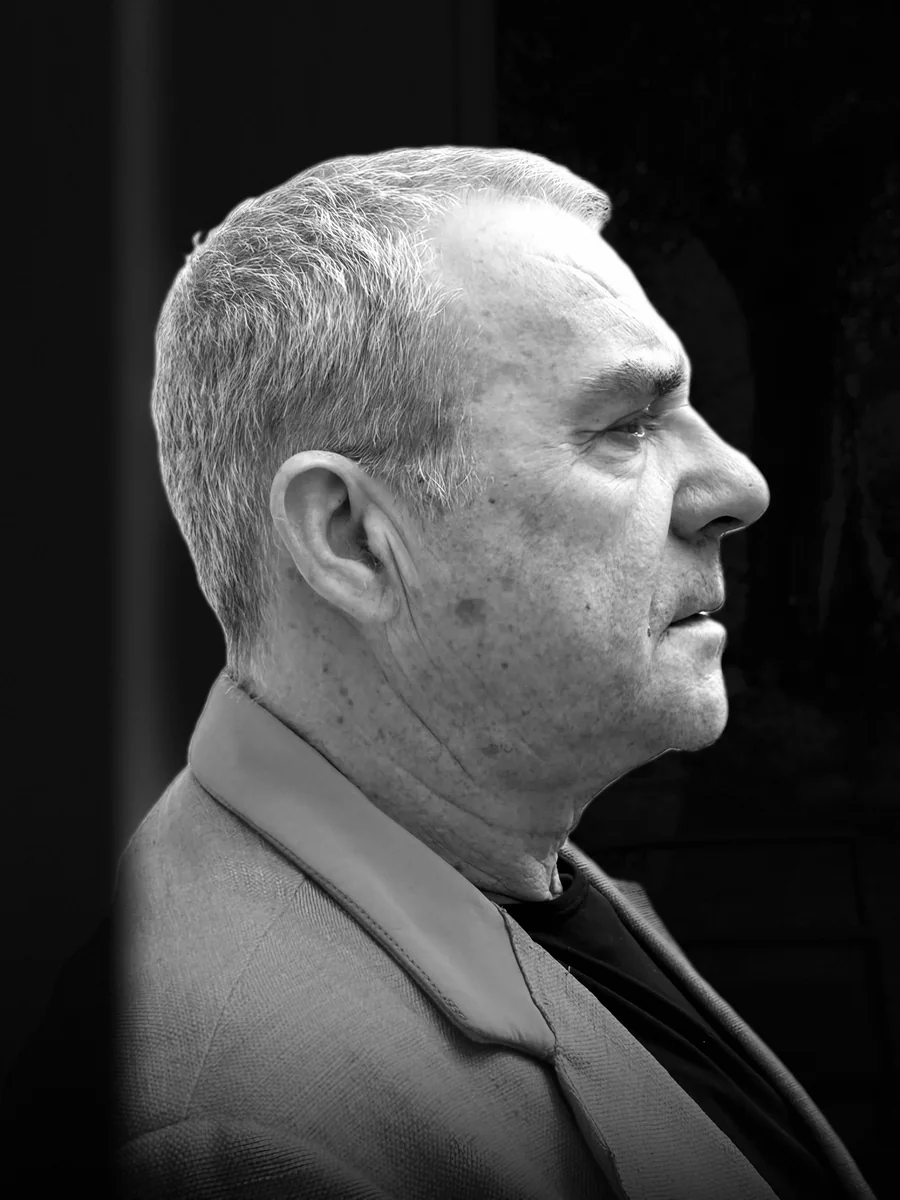
Roberto Giovannetti was born in Senigallia in 1963. Here is his story and, in his own words, the thinking behind Arte Benessere.
Biography
Origins and formation
Roberto Giovannetti was born in Senigallia (Ancona) on 6 May 1963. His path as an artist does not begin with an academic vocation, but with an intuition of the heart in his earliest years, which remains its generative core and, decades later, the key to reading it.
At around the age of eight a wish surfaced in him, as simple as it was radical: that people might live in well-being, healthy and happy. It was not an aspiration to higher knowledge or a precocious intellectual programme, but a spontaneous movement of the spirit, with no declared purpose. That very absence of intention makes it an authentic origin: a seed that settles deep down and waits for its time.
During his formative years that wish survived as a latent sensitivity, felt more than thought. Before art appeared as a language, a constant attention took shape in him to the balance and harmony between individual, environment and perception, together with the need to understand the inner dynamics of the human being and to bring its spiritual, emotional and sensory dimensions back together.
A search that never ended
Between the ages of twenty-four and twenty-five a personal search began. Its formative phase lasted about fourteen years, and it has never stopped since. It did not spring from a plan or a defined goal. With time the original wish had probably slipped out of conscious memory; yet it went on working in him as an unconscious tension, able to guide choices and encounters.
Life itself became the guide. Meeting certain people and spending time in particular places set off a sequence of experiences that led him, step by step, towards new fields of knowledge. Only afterwards did the artist recognise the coherence of that apparently unplanned path: every stage descends from that primordial aspiration to the well-being of others.
From a holistic perspective he explored the relationship between man and the universe, with particular attention to the energetic dynamics and perceptual flows that run through the individual. At the centre of the inquiry are inner listening, the language of the body, intuition and the ability to grasp the signals of everyday experience and of the environment.
In the first eleven years he explored different fields of knowledge, through study, experiential practice and disciplines oriented towards self-awareness. This is the theoretical and experiential basis of the later research, in which well-being is not a simple psychophysical condition but a deep harmonisation between individual, space and perception.
In the following years his interest moved towards environments and the way they affect the quality of human perception. Giovannetti approached Taoist geomancy, a discipline founded on the relationship between energy, balance and the configuration of space. In parallel he studied building materials and everyday objects, electromagnetic fields and the relationship between architecture, matter and well-being. The passage from the inner dimension to the environmental one would prove decisive for the evolution of his poetics.
Those fourteen years do not mark a point of arrival, but the first season of an inquiry that continues today. The Composizioni pittoriche, Macro Arte and Vision are its successive forms: stages of a living search that goes on questioning the relationship between the human being, space and well-being.
The birth of the Composizioni pittoriche
Feeling the need to gather and reflect on what he had learned, Giovannetti allowed himself a sabbatical. In that condition of silence and listening, inner visions surfaced, which he spontaneously translated into painting. Painting was thus born as a direct outcome of the earlier search, not as an academic choice or a professional plan. Without a traditional artistic training, the artist developed an intuitive and personal language, free of preconceived schemes.
So came what the artist calls Composizioni pittoriche, pictorial compositions: works conceived as a whole of spiritual and archetypal meanings and of different kinds of knowledge, in which forms and colours meet and interpenetrate, expressing states of mind and inner resonances.
From 2000 he began a continuous production, marked by constant experimentation, free of any artistic context, and by a gradual technical evolution. From the very first works, many viewers reported a feeling of inner well-being and of perceptual involvement. The artist recognised in this a correspondence with the path of the previous years and with the wish that had accompanied him from the beginning.
Over time the painting was also enriched by the exchange with viewers, artists and connoisseurs, who recognised in it an autonomous and immediately recognisable vision. The compositions are perceived not only as images but as perceptual devices able to activate an inner experience and to lead the viewer towards a dimension of listening often neglected in contemporary life. A decisive stimulus came from the many testimonies, written and spoken, of people from different walks of life, describing a state of well-being experienced in front of the works.
Poetics: being well in one’s inner sphere
At the centre of Giovannetti’s research is the idea of “being well in one’s inner sphere”: a path experienced first-hand, in the conviction that reconnecting with oneself is the main road to the evolution of the being. His compositions offer an experience of beauty, harmony and balance that sets the work in dialogue with the viewer’s intimacy.
The work thus becomes a means of recognising one’s own submerged dimension and coming into contact with it: a first step towards a better quality of life. With time the artist came to consider his painting a gift received, and he welcomes with humility the work’s capacity to generate perceptual effects. In his own words:
“The art I express comes from a dimension I do not know; I thank God that I can grasp its essence and bring it to light. I am only the means.”
The compositions are not made with the intention of generating well-being. The artist does not paint to obtain an effect: he receives a vision and brings it to light. The well-being viewers report is a consequence, not an aim, and in this disposition lies his idea of himself as the channel of the work rather than its maker.
Consistent with this vision is a precise choice: Giovannetti does not sign the front of his compositions, which are signed on the back of the canvas. When a work is complete, the artist himself is struck by it; a signature on the surface would alter its wholeness and balance. In his conviction, a work remains traceable to its author even without his distinctive mark.
The renunciation also has a deeper meaning. For the artist the signature is a manifestation of the ego, a feeling to be scaled down to leave room for the intelligence of the heart, rather than for the mental one that feeds the rational part and the ego itself.
The discovery of Macro Arte
For a long time Giovannetti chose not to put his works on the market, sensing that they held potential still unexplored. For about three years he deepened his observation and study of them, without clearly identifying the direction the research should take.
The turning point came unexpectedly. Having found by chance a macro lens he did not remember owning, the artist tried it on one of his compositions. Focusing on the painted surface, he discovered a universe invisible to the naked eye: details, depths, layers of colour and autonomous forms emerged from within the work like new visual landscapes.
A decisive awareness followed: the pictorial composition is not a finished image, but a living organism that holds further perceptual levels. So Macro Arte was born, a term coined by the artist to indicate the passage from the microcosm to the macrocosm of the work. Its founding principle is not the reproduction of a detail, but the recognition of a new work within a work already complete. Macro photography is the instrument of inquiry; the artistic act lies in the intuition that identifies, in the painting, a second expressive possibility. Not every composition holds one.
“It is not the detail that creates the work, but the artist’s sensitivity in recognising, in that detail, the existence of another work.”
In this process painting goes beyond its physical limits and becomes an environmental and perceptual experience. Macro Arte thus also takes on the value of a metaphor of consciousness: an invitation to go beyond the surface of things and reach a deeper dimension of experience. The artist uses a telling image: seen from space, the Earth appears as the “blue planet”; coming closer, one makes out oceans, deserts, mountain ranges, rivers and hills. In the same way, Macro Arte reveals in the composition what ordinary observation does not catch.
In making it the artist keeps to strict principles:
- the original composition is always a complete and autonomous work, never a preparatory stage;
- the colours and the movement of the paint remain the original ones: nothing is repainted or reinterpreted;
- every selection comes from long observation, and only a few details are considered suitable to become Macro Arte;
- every image is made in a limited edition of 50 copies for each artistic line, to protect its authenticity.
Critical position
In the 1970s the idea of isolating a fragment of the painted surface had already appeared in some artistic research. The detail was photographed and then repainted in large format, or broken down into photographic study series. In both cases it was a tool for analysing the relationship between painting and photography: the fragment returned to painting or remained a document.
Roberto Giovannetti’s Macro Arte follows a profoundly different direction. The fragment does not return to painting and does not stop at analysis: it becomes a new, autonomous work, and painting evolves into another form of art without being repainted or reinvented. The difference rests on four aspects:
- The composition as matrix. Every Macro Arte work comes exclusively from one of the artist’s pictorial compositions. The canvas becomes a living archive from which ever new works can be born, each organically tied to its origin.
- From matter to digital, with a protocol of fidelity. No alteration of colour, no change to the movement of the paint. The image reveals, without manipulating, what the eye does not see.
- An existential genesis. Macro Arte does not come from a theoretical inquiry into artistic language, but from an inner listening matured through experiences aimed at his own personal evolution: a path that led him to art through painting, and from painting to Macro Arte and its later developments.
- An environmental and multisensory destination. The image is conceived for lived-in space and takes shape in seven artistic lines that involve sight, smell, hearing and touch.
It is in this continuity between inner experience, painting, digital image and space that Giovannetti’s research finds its most personal identity.
The Arte Benessere project
The whole artistic project is called Arte Benessere. It is not one line among others, but the founding theme of Giovannetti’s work, with roots that precede art itself by many years. Well-being was born as a wish for others, even before it became a personal search; it then became an inquiry into the human being and into environments, and only later found its visible form in painting. For this reason the artist wanted to place its origin where everything began, and to follow its path as far as art and the testimonies of well-being the works have prompted. Well-being is therefore not a chosen theme, but the condition that has always driven the research.
The project is organised in three chapters, gathered in two catalogues: COMPOSIZIONI PITTORICHE, which collects the original works, the first matter of the whole path; MACRO ARTE, which presents the artistic lines and the collection of Macro Arte images and includes, as its third part, VISION.
Macro Arte is not a language separate from painting, but its natural perceptual evolution. The work is no longer only an object to contemplate: it becomes a presence able to change the relationship between individual, environment and sensory perception. Like painting, Macro Arte too generates well-being, as if it were continuing its journey from one artistic dimension to another.
From this evolution seven artistic lines take shape, presented in detail in the MACRO ARTE catalogue. In each one the image meets a material and offers a different visual perception; in the first three it also acquires a second function, dedicated to well-being. Arte Olfattiva joins the image to a fragrance, Arte Acustica sets it on a sound-absorbing panel, Arte Materica on a bas-relief. The three variants of Arte su Alluminio and Arte su Plexiglas complete the path, with their essential and luminous rendering. As the artist says, it is not the technologies that determine the work, but the work that acquires new qualities.
Vision: art in dialogue with space
Vision is the chapter in which Giovannetti’s research leaves the dimension of the single work and is fulfilled in lived-in space. It comes from the conviction that art can contribute to a person’s well-being, turning everyday environments into places of harmony, balance, emotion and identity. The work is not simply placed in a room: it becomes a living presence, in dialogue with the architecture, the light, the materials and, above all, the sensitivity of those who live there.
Vision is first of all a path of artistic direction, which the artist follows personally from listening to realisation. Everything begins with the dialogue with the client and the reading of the place: colours, materials, proportions and light.
The projects cover four fields: residences, hospitality, offices and experience installations, in which the work leaves the wall and becomes an environment to walk through. The different lines combine to involve all the senses: acoustic art softens reverberation and background noise, light shapes the atmosphere, fragrance leaves a subtle and personal memory in the space.
Alongside the seven lines, when a special place or a specific study calls for it, the artist adopts further design solutions: Arte Luminosa, in which the backlit image becomes a source of light, Pellicole Artistiche, artistic films with different levels of performance, and Arte Applicata, with painted interventions made directly on surfaces.
The aim of Giovannetti’s research lies not only in the work itself, but in the capacity of art to lead the individual back towards their inner dimension. In this vision well-being is born first of all from a state of deep awareness, and art, together with the environments in which we live, can become an instrument of perceptual, emotional and sensory reconnection with oneself. The wish born so many years earlier thus finds, in everyday space, its most complete form.
“Art is not only something to look at. It is a presence to be lived.”
My philosophy
Beyond the visible, towards self-knowledge
The text that follows is by Roberto Giovannetti, written in the first person.
Art as an expression of the soul, an experience of well-being and an instrument of inner evolution.
At the origins of my search
My art is not born from the wish to become an artist, but from a deep trust in the human being, in its often unexpressed capacities and in the extraordinary possibilities of evolution it holds within.
I remember that, at about the age of eight, I had a wish as simple as it was deep: that people could be well, healthy and happy. I could not imagine then how much that thought would guide, even unknowingly, the course of my life.
My search started first of all from myself, from the wish to know myself, to improve and to understand as far as possible the complexity of the human being and the meaning of the experiences that accompany our existence.
I have always believed that within each of us there are potentialities we are often unaware of, and that self-knowledge is one of the fundamental conditions for recognising and expressing them.
I have never thought of this search as a path aimed at reaching an absolute truth, but as a continuous process of learning, transformation and inner growth.
Between the ages of twenty-four and twenty-five I set out on an intense path of personal research which, in its most significant phase, unfolded over about fourteen years and which, in truth, has never ended.
I explored the relationship between man and the universe, between matter and spirit, between reason and feeling, between perception and awareness, later extending my interest to the relationship between the human being and the environments in which it lives.
Along this path I came to the conviction that well-being develops through a deep and dynamic relationship between our inner dimension and the world around us. If on the one hand self-knowledge and personal growth are fundamental elements of our evolution, on the other the outer conditions too can help to stimulate and accompany this process.
Painting emerged spontaneously from this experience. I did not look for it, I did not plan it: it appeared in a period of my life devoted to silence, to reflection and to the need to absorb what I had learned.
It became a language through which to give form to something that words alone could not express.
Today I recognise in my artistic expression the natural continuation of that personal search.
Three expressions of a single philosophy
My artistic research has developed over time through a natural process of deepening and evolution, giving rise to three complementary expressions, presented in two catalogues: Composizioni Pittoriche and Macro Arte, within which the VISION project also unfolds.
Composizioni Pittoriche
They are the origin of my artistic expression, the moment in which a dimension that cannot be seen finds a way to manifest itself through colour, forms and matter.
Macro Arte
It is born from going deeper into the pictorial composition and from discovering new artistic identities held within it, taking on a philosophical meaning tied to self-knowledge and to the unexpressed potential of the human being.
VISION
It is a further evolution of my research, through which art enters into dialogue with architecture and with the environments of everyday life, exploring the relationship between space, inner life and well-being.
These are not independent paths, but different manifestations of a single thought.
From inner life to matter, from matter to the discovery of new dimensions, and on to the dialogue with the environment, an evolutionary process unfolds in which art and life become expressions of the same search.
The artist as a means
I do not consider the creative act solely the result of the artist’s will, knowledge or technical ability.
While making my pictorial compositions I feel that I enter into relationship with a dimension I do not claim to know or to explain completely. Forms, colours and matter become instruments through which something finds the possibility of manifesting itself.
From this perception comes a thought that has always accompanied my search:
“The art I express comes from a dimension I do not know; I thank God that I can grasp its essence and bring it to light. I am only the means.”
I live this possibility as a gift, recognising in the creative act not only a personal expression, but also an exercise in humility, in listening and in openness towards what I do not yet know.
The silent dialogue with the work
When I finish a pictorial composition, my relationship with it does not end. Instead a new phase begins, deeply intimate and personal.
I usually place the newly finished painting on an easel at the foot of the bed, in my room, where I can look at it calmly, away from the demands of daily life.
I dwell on the colours, the forms, the movements of the matter and the details, trying to enter the work and letting the work itself reveal to me what it holds.
Often I too am surprised by what I have made, discovering aspects I had not consciously perceived during the creative act.
Sometimes the painting stays in front of me for weeks, at other times for months. There is no set time. I let this dialogue mature naturally, until I feel I have received and absorbed what the work, at that particular moment of my existence, could give me.
In this phase I am no longer only its author: I become its observer.
When I feel that this encounter has run its course, I am ready to let the work go, so that it can set out on its own path and meet other people, other sensitivities and other inner worlds.
It is from that moment that the search for the possible expressions of Macro Arte held within it also begins.
The work beyond the work. Microcosm and macrocosm
Macro Arte is born from the discovery that a pictorial composition, though complete in its own identity, can hold other artistic realities within it.
Through a macro lens I enter the matter of the painting, looking for details able to express a visual and emotional autonomy of their own, without altering the colours, the forms or the original movement.
It is not simply a matter of enlarging a detail, but of recognising a new work within a work that already exists.
Just as the Earth seen from space appears as one, and then, as we come closer, reveals countless landscapes and realities invisible before, so a painting can hold whole universes within a small fragment of matter.
“Everything was already there. Only the depth of our gaze has changed.”
I recognise in this process a deep correspondence with my personal path: just as in life I began the search from myself, so in my art I discovered new dimensions by entering the depth of my own creations.
Microcosm and macrocosm become expressions of one and the same philosophy.
I believe the human being is involved in a continuous process of evolution, even when not fully aware of it. Macro Arte is meant as an invitation to take a more active part in this evolution, not to stop at appearances and to look for new worlds within oneself.
The freedom of perception
One of the fundamental principles of my philosophy is respect for the human being’s freedom of perception.
For this reason I choose to sign my pictorial compositions only on the back. I do not want my name to interfere with the image or to come between the work and the person looking at it.
In the same way, except for particular artistic projects with a precise conceptual path, I prefer not to give my compositions titles.
A title or an explanation given beforehand can steer, even unconsciously, the viewer’s perception, limiting its spontaneity.
I do not want a person, standing before one of my works, to feel they must ask what I meant to represent. I would rather they asked themselves:
“What does this work stir in me?”
Every individual has their own history, their own sensitivity and a unique store of experiences, emotions and awareness. It is through this personal richness that the work is perceived and interpreted.
There is no single reading to look for, nor a right or wrong answer.
Even the same person, looking at a painting at different moments of their life, can find new sensations and meanings in it.
The work remains materially unchanged, but the human being evolves and, with them, the relationship they establish with it is transformed.
It is in this continuous possibility of encounter that I recognise one of the most authentic forms of the vitality of art.
Beyond the paradigms of the art system
Over time, the art world has developed an articulated system of relationships between artists, critics, gallerists, dealers, collectors, museums, the media and the public.
A system I recognise and respect for its history, its organisation and the contribution it has made to the spread and appreciation of art.
My path, however, has led me towards a different perspective.
It does not come from a wish to oppose or criticise existing structures, but from the need to be consistent with what I have lived and with the principles that gave rise to my artistic expression.
I wish to follow a road on which the relationship between artist, work and viewer can develop directly, without the need for interpretive superstructures or mediations that come before personal experience.
I believe art is born, first of all, to be seen, observed, perceived and lived.
Knowledge, critical thought and cultural study can certainly enrich the experience of art, but I do not believe they must necessarily come before it or determine its value for the person living it.
My trust in the human being leads me to recognise the dignity of individual perception, regardless of cultural background or knowledge of the art world.
One need not be an expert to be moved by a work, just as one need not know the artist’s intentions to establish an authentic relationship with it.
I wish to recognise in the viewer not only the role of observer, but that of an active part in the life of the work.
The encounter with the other
It was the people who met my first pictorial compositions who made me understand that what I was making could have a meaning beyond my personal experience.
Their spontaneous testimonies, the emotions, the feelings of serenity, energy, introspection and well-being they told me about were the spark that gave me the motivation to continue.
Without that particular form of empathy, painting would probably have remained a private dimension of my life.
It is thanks to these people that my artistic research continues to evolve today.
For this reason I do not intend to change the order of the values that emerged naturally along my path, giving more importance to the dynamics of the market than to the human relationship that gave my art its meaning.
The public, in my experience, is not the last link in a system, but the engine that has given continuity to my artistic expression.
If one day my art were no longer able to arouse that particular form of empathy, one of the fundamental reasons that lead me to express myself through it would be gone.
Reason, feeling and awareness
We live in a society that constantly urges us to interpret, analyse, classify and judge.
I do not mean to deny the value of reason, but I believe it should not be the only instrument through which we understand existence.
When the mind takes on an excessively dominant role, we risk feeding the dynamics of the ego, the need for control and the need to reduce every experience to an explanation.
We have, however, other faculties just as precious, to which we do not always give their due: intuition, sensitivity, the ability to listen and to come into contact with our deepest feelings.
I believe the evolution of the human being also passes through a greater balance between these dimensions, until we rediscover what I consider the noblest feeling: love.
The encounter with a work of art can be an occasion to exercise this sensitivity, granting ourselves a space in which it is not necessary to understand everything rationally, but in which we can simply listen to what happens within us.
Arte Benessere. Art as an act of love
Among the many testimonies I have received over the years, there is one I always remember with particular pleasure and which, perhaps more than others, caught the essence of my artistic expression.
A person, after coming to know my works and the artistic project, described the art I bring forth as an act of love.
In those words I recognised a deep correspondence with the wish I had had since childhood and with the meaning of the whole path that came from it.
Perhaps, without being fully aware of it, through art I found a form of expression that gave continuity to that original wish.
It is in this dimension that the meaning of Arte Benessere is to be found.
I do not attribute a therapeutic function to art, nor do I claim that it can produce the same sensations in every individual. I believe, rather, in its capacity to enter into relationship with human sensitivity, favouring occasions of harmony, emotion, introspection and awareness.
Art can become a stimulus to change, both through the intimate experience of observation and through its presence in the environments that accompany our daily life.
The deepest aim of my search is held in a thought as simple to state as it is complex to achieve:
“Being well in one’s inner sphere.”
VISION. The environment as mirror and possibility of evolution
Our inner dimension is in continuous relationship with the outside world.
I consider the environments in which we live, the objects we choose and the way we organise our spaces a possible manifestation of what we are, of our needs, our sensitivities and our degree of awareness.
The environment is, in this perspective, a mirror of our inner life. But this relationship does not run in one direction only.
If what we are within helps to shape the world we surround ourselves with, a conscious transformation of that world can also become a stimulus to our own change.
Acting on the outer environment does not mean replacing inner work, but accompanying it with a different and complementary experience, able to prompt new perceptions, sensitivities and states of mind.
We should ask ourselves more about the authentic value of the things we bring into our lives, distinguishing what answers a deep need from what simply derives from habits, conditioning or external models.
Choosing materials, colours, light, sounds, scents and artistic presences with greater awareness also means questioning the quality of our own existence and the relationship we wish to establish with ourselves.
It is on these premises that VISION develops: not simply as an expression of art applied to architecture, but as a search aimed at creating environments more in tune with the inner nature of the human being.
A space can mirror what we are today, but it can also be a call towards what we can become.
It is in this possibility that I recognise an evolutionary value of the environment.
The different forms my research takes through the Macro Arte images (Arte Olfattiva, Arte Acustica, Arte Materica, Arte Luminosa, Arte su Alluminio, Arte su Plexiglas and applied painted interventions) come from the wish to explore many kinds of relationship between work, person and space.
The choice of supports and materials also takes on a meaning that goes beyond the aesthetic. Each support, carefully selected for its characteristics, gives different visual effects, depths, luminosities and perceptual perspectives of the same artistic image.
Art thus becomes an active presence in everyday life, a call to beauty, to harmony and to the possibility of living in a different condition.
It is not simply a matter of making the space around us more beautiful, but of creating the conditions for it to enter into dialogue with our inner life, to accompany its changes and to prompt new awareness.
Just as our inner evolution can transform the world we surround ourselves with, so the conscious transformation of our environment can accompany and stimulate our inner evolution.
Beyond the visible
My artistic philosophy is, first of all, a philosophy of life.
I do not wish to offer definitive answers, but to stimulate curiosity, the capacity for observation and the desire to know oneself.
To believe in the human being means, for me, to recognise that its identity is not something immutable, but a reality in continuous evolution, rich in possibilities still to be brought forth.
The path I set out on, starting from myself, has taught me how important it is to keep alive the will to learn, to improve and to welcome what we do not yet know.
We can take this path by listening to our inner life, but also through a more conscious relationship with the outside world, recognising the value of the experiences, the encounters and the environments that accompany our existence.
Art, in its freedom of expression, can become part of this path, an occasion to reawaken sensitivity and to bring us closer to a more authentic dimension of ourselves.
To go beyond the visible does not mean to move away from reality, but to learn to perceive it more deeply, recognising the richness hidden both within us and in what surrounds us.
I believe one of the most authentic possibilities of the human being lies in the capacity to consciously transform oneself and the world one lives in, so that both can become the expression of a continuous evolution towards knowledge, harmony and love.
Roberto Giovannetti